
Industry captains send a message to Kamenický
10.09.2025 09:53
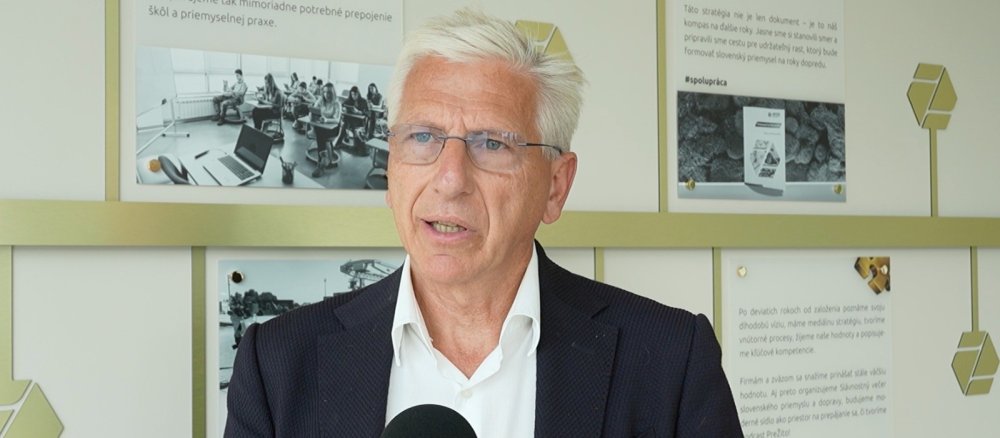
You squandered a great opportunity, your savings are insufficient
On Tuesday, Minister of Finance Ladislav Kamenický presented the consolidation measures for next year. How are they assessed by representatives of employers' associations and the heads of the automotive and industrial sector? Business sends a message: the state is saving too little and, moreover, it does not communicate with entrepreneurs.
When will the state finally start saving on itself too? That is one of the most frequent questions of citizens, but also of small and large companies. After all, it was on their shoulders that the previous two rounds of consolidation rested, from which the government expected a benefit of up to 4.7 billion euros.
Representatives of business and the largest employers repeated that things cannot continue this way. Slovak companies are on the verge of competitiveness, they are beginning to lose key investments, and further burden may deprive them of orders or even threaten their future.
That is also why the concerns about the third consolidation package, which Minister of Finance Ladislav Kamenický presented on Tuesday, were so significant. This is especially the case after the government, according to employers' associations and associations, once again maintained its reputation – it did not communicate anything with business.
That Slovakia must consolidate is hardly disputed by anyone today. The state of public finances is tragic, and if we continued along the well-worn tracks, the result would be a Greek scenario. „Without the necessary changes, we would already reach debt at the level of 100 percent in 2036,“ said Kamenický when presenting the third package.
So how does the private sector assess the solutions that are supposed to bring 2.7 billion euros into the state treasury?
We are expensive, companies are losing orders
There are several reasons, but the main one is the increase of the health insurance contribution by one percentage point, which will affect both employees and the self-employed. Thanks to this, approximately 358 million euros are to be added to the state coffers. „Even before the introduction of the new higher minimum wage, which will affect the amount of all employees' bonuses, Slovakia is the third most expensive country in Europe in terms of the cost of labour. We have already overtaken even Germany,“ states Petr Bláha, head of the chemical company Duslo Šaľa.
Even though the increase in the contribution formally concerns employees, it can be expected to strengthen the pressure on wages. After all, most people watch only one thing on their pay slip. „I am mainly interested in how much the company sends me net to my account,“ explains Peter, who works for Jaguar Land Rover. He adds that he and his colleagues will definitely notice a lower net income.
That is why they plan to demand that their employer compensate them for this shortfall. How the employer will deal with this, however, is questionable. Companies have long pointed out, like Bláha, that Slovakia lost its advantage in the form of lower wage costs a long time ago. „Everyone around us is cheaper,“ said the head of the Automotive Industry Association Alexander Matušek in an interview for HN.
This is also evidenced by the fact that our plants have begun to lose, in internal competition, key products that are heading to other corners of Europe. An example is the loss of the electric model ID.1 at Volkswagen in Bratislava, as well as of the model of the Leapmotor company, which could have been produced at Stellantis in Trnava.
According to HN's findings, the European parent companies decided in the first case for Portugal and in the second for Spain. „It is true that the inflow of investment has stopped. That is a pity, because it was precisely from the expansion of companies and economic growth that we could have covered part of the consolidation,“ claims the head of the Association of Industrial Unions and Transport, Andrej Lasz.
Demotivation of young entrepreneurs
Higher contributions are also to concern the self-employed. In the last rounds of consolidation, they saw an improvement of conditions in some cases, but that no longer applies. The minimum social contributions of the self-employed will increase by 20 percent, and the contribution holiday is also to be shortened to five months. Into the state budget, these solutions are to bring a total of more than 220 million euros.
According to the president of the Association of Employers' Unions and Associations, Rastislav Machunka, the tightening of conditions for the self-employed goes „directly against the spirit of support for small and medium-sized enterprise“. Instead of the state motivating and supporting beginning entrepreneurs, it does, according to him, the exact opposite.
In addition to contributions, companies face a further burden in the form of an extension of the period during which the employer pays out the employee's sick leave – from 10 to 14 days. According to the association, the change will force entrepreneurs to create new reserves for unplanned expenses, the amount of which naturally cannot be estimated in advance.
Companies are at the same time asking about the meaning of the one-off cancellation of holidays as days of rest. Although they are supposed to bring income at the level of 230 million euros, it remains a question what measure will replace this shortfall in the following years. A partial answer was offered by Minister Kamenický, who plans to focus more on banks and retail chains in the future.
You are saving too little on yourselves, business sends a message
According to Alexander Matušek, the main problem of the consolidation is that the state transfers almost the entire burden onto others. He claims that in the last two rounds it planned to obtain up to 96 percent of the financing from the revenue side, that is, from new taxes, the amount of which was to reach 4.7 billion euros. „Despite the fact that we have so far consolidated approximately three percent of gross domestic product, the deficit is still at the level of 5.2 percent. That is why it looks as if we have not consolidated anything at all,“states Matušek.
Machunka adds that economic theories say that successful and sustainable consolidation should be built approximately 70 percent on savings in public expenditure and only 30 percent on revenue. „The government, however, did not maintain this balance and also squandered the opportunity to cancel populist social measures, such as the thirteenth pensions or free lunches, which are financially unsustainable in the long term, because they represent billions in expenditure every year, growing faster than the economy,“ claims the AZZZ president.
According to companies, the measures themselves are moreover non-specific, vague, and the speed of their implementation is also questionable – for example, in the abolition of offices. Not to mention that until now it has not been published how much each ministry is to save. This is supposed to happen only after today's government session.
Continuation of the article on HNonline.sk.

