
Transaction tax – how to handle it in practice?
24.04.2025 13:10
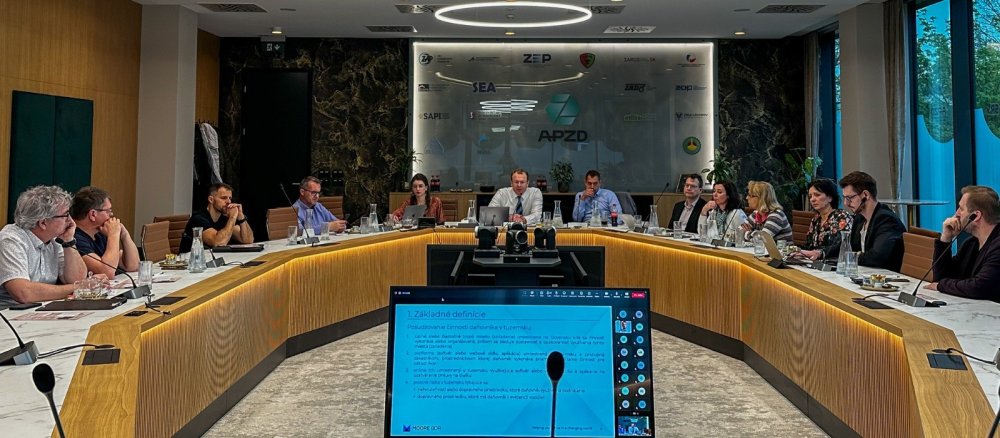
The introduction of the tax on financial transactions from 1 April 2025 raised many questions in the business environment. The absence of previous practice and case law, as well as the specifics in the way tax is withheld by banks, brought a considerable degree of uncertainty. That is also why the Association of Industrial Unions and Transport organised an expert seminar in cooperation with Moore BDR and Tatra banka, focused on explaining the practical aspects of the new legislation, the calculation of the tax and the identification of exempt entities and transactions.
From April 2025, the transaction tax affects everyone who does business, unless they are explicitly exempt by law. The taxpayer is every entrepreneur – a natural or legal person – who has a payment account in the country or carries out business activity in Slovakia. Excluded from taxpayers are, for example, civil associations, foundations, non-profit organisations, special-purpose facilities of churches, research and development entities (for example SAV) or tourism organisations. These entities must prove to the bank that they are not taxpayers by means of an affidavit – unless the bank has automatically identified them as exempt.
Subject of the tax and types of taxable transactions
Mainly three basic categories of transactions are subject to taxation: cashless transfers from an account (e.g. payments of invoices or wages), cash withdrawals from an ATM and so-called recharged costs, where the transaction is first carried out by another entity and the costs are subsequently refunded. A flat-rate annual tax for the first use of a payment card in the amount of 2 euros is also introduced.
On the contrary, the transaction tax does not apply to payments of taxes, levies and fees to the State Treasury, to transfers between one's own accounts within the same bank, nor to ordinary card payments for goods and services (with the exception of cash withdrawals).
Tax rates and settlement regime
The rates are set by law as follows: 0.4 % of the volume of cashless transfers (with a maximum of 40 € per transaction), 0.8 % for cash withdrawals and 2 € per year per payment card.
Specifics for bulk orders and recharged costs
In company practice, so-called bulk payment orders also play an important role, in which, for example, the payment of wages or the settlement of several invoices is carried out by a single order. Although such an order may appear on the bank statement as a single amount, the transaction tax is calculated individually for each item. This means that the maximum cap of 40 € applies to each individual transaction, not to the entire aggregate order.
Special attention is also required by recharged costs. If a company is unable to reliably prove the purpose of a given payment, it may become obliged to pay the tax without the right to apply the maximum limit. In practice, this may occur, for example, with leases involving energies or with refunds from insurance companies, where there is no direct link between the service provider and the taxpayer. Responsibility for the correct identification of these transactions lies exclusively with the taxpayer – not with the bank.
Obligations of entrepreneurs and records
The first taxation period is April 2025 and the tax must be paid by the end of the following calendar month. Entrepreneurs have the obligation to keep electronic records of all taxed transactions and to retain them in case of a tax inspection. The notification of the amount of tax is at the same time considered a tax return. If a company does not carry out any taxable transaction in the given period, the law does not require the filing of a so-called zero return.
Complaints and exemption
In the case of an incorrectly taxed transaction, it is possible to file a complaint. Companies should check in time whether their accounts or their legal form meet the conditions for exemption from the tax. If they are not automatically exempt, it is recommended to submit an affidavit to the bank.
A practical view from company practice
The seminar organised by APZD offered participants a practical view of how the transaction tax works. Experts from Moore BDR and Tatra banka – Igor Rusnák, Martin Kiňo and Peter Bilčík – presented specific examples from practice, drew attention to the differences between types of accounts, entities and transactions, and discussed situations in which ambiguities or an erroneous calculation of the tax may arise.
A change that requires attention
For companies in industry and transport, the transaction tax means an intervention in everyday operations. It is not enough just to adjust payment habits – internal processes need to be set up properly, records kept in order, and one must be able to communicate with the bank as well as with the Financial Administration. APZD therefore recommends following verified information sources and, in unclear situations, rather consulting experts.
Source: APZD

