
We know of many companies that are already moving production abroad. The reason is the transaction tax
10.01.2025 14:15
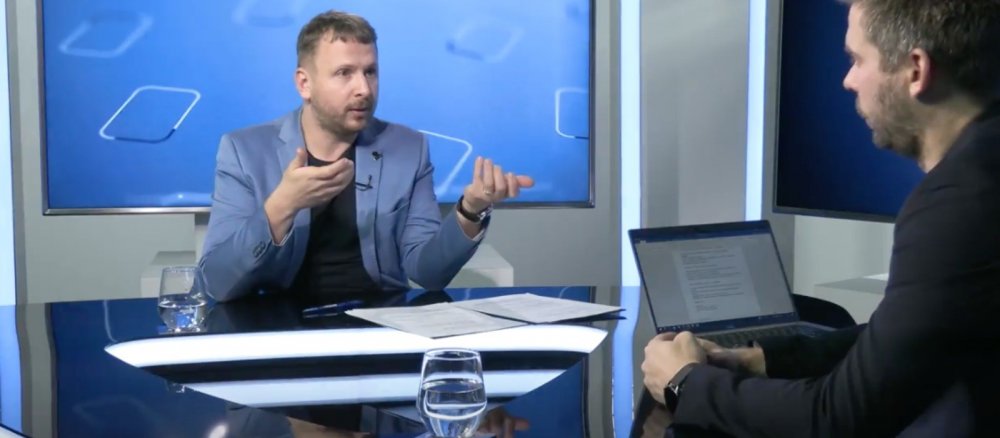
In an interview with the Secretary General of the Association of Industrial Unions and Transport, Andrej Lasz, you will learn:
- What condition Slovak industry is in.
- Whether the crisis in Germany has already fully manifested itself here.
- Why our carmakers are resisting unfavourable trends.
- Whether we may see changes in Brussels's green targets.
- What changes in recent months were driving investors out of our country, especially to the Czech Republic.
- What changes the segment needs and where we should draw inspiration.
In our last interview from the summer you stated that we would soon see the slowdown in Germany in Slovak industry too. Are we already feeling this slowdown since the summer, or will it come in full only after the New Year?
We are already feeling the slowdown in full, but it will definitely continue in the coming months as well. After all, people working in our industrial enterprises can see even today that production is mostly not running at full capacity, some shifts have been suspended, weekend production and the like. Our members themselves report to us that the volume of their production is not at the level it usually is towards the end of the year.
Can it be said which segments are involved?
In general we can say that this situation affects the automotive, engineering, electrical engineering and metallurgical industries. The overall picture is also completed by the data of producers of metals and concrete. With them, their customers have to place orders in advance, on the basis of which the further development of the segment can be estimated. And today we can already see that precisely their orders are facing a decline.
Can we therefore expect a further worsening of the situation?
Yes, we have for quite some time been saying that we are on the brink of recession. World markets have recently grown significantly, so we can expect at least a correction, but probably also a recession. If we look at the results of various stock indices, for example the S&P 500, then the growth of the index of a total of 500 companies in the recent period is attributable to eight, perhaps ten players dealing with artificial intelligence, semiconductors, such as for example Nvidia and others. In Slovakia, however, we still do not have production of this kind.
In recent years industry has had to face a pandemic, a shortage of semiconductors, a problem with logistics, extremely expensive energy, and I could go on. But it seemed that the situation had already calmed down. What negative factors are affecting Slovak industry today?
If I look at the past year, then what affects us most negatively is the poor predictability of legislation. So that I am not only criticising, I must also praise the things that have succeeded. For example, in the case of the Ministry of Education, changes have occurred that we had been calling for for decades. We are partially reducing the number of secondary schools, of which we have more than 800, while in our opinion we would make do with a number of 200 to 300. They began to support quality schools more, and a reform of lifelong education is also under way. We also see positive changes in the area of the labour market, where it was possible to make changes in the area of foreign worker import systems. There are, admittedly, still shortcomings, but the process has been significantly sped up.
So where is the main problem?
The problem, however, is that in the area of further legislation we see really great unpredictability from the point of view of what conditions companies will have. We saw the unfortunate consolidation package, which was adopted absolutely without discussion with anyone, and we also see deputies' proposals of the sports vouchers type and other senseless populist proposals and nonsense that companies are supposed to pay for. Furthermore, one must realise that a company has only one wallet, which must be divided up. Among energy, among production, among employees and so on. The income and expenses in such a wallet are at the same time planned for years ahead. Automotive production, for example, operates in seven-year cycles, and upon obtaining a product they have to commit to what costs they will have during that period. Also as a consequence of such populist proposals, we are becoming ever less attractive to foreign investors. I am not claiming that we will immediately see layoffs or the loss of individual projects.
Industrial production in the entire euro area is stagnating, while in Slovakia it showed growth at the level of 1.3 percent. Was it mainly car production that pulled it forward?
Personally, I very much dislike commenting on the data of the statistical office. One must realise that these are mainly orders, which in a certain period face a decline, at other times an increase, and in general they are volatile. Yes, it is true that car production specifically rose year-on-year by 20 percent. There is nothing to be surprised at. We have long claimed that the automotive industry is the backbone of our industry, accounting for as much as half of our exports.
Is that not a paradox? We see what state the European automotive industry is in, and at the same time many often remind us that precisely the strength of this sector can make our country a European Detroit. Our carmakers, however, are evidently prospering compared to many other European ones. Can it therefore be said that we are simply lucky in what products foreign carmakers placed in Slovak plants?
The whole result definitely depends on what products are produced here. But let us not take this situation as given and as something that must always be here. The individual portfolio of producers changes over time too, and it is always necessary for them to fight for new vehicles. That is also why we constantly push for the improvement of the business environment. Because even that carmaker can lose the fight for a product to its internal competitor somewhere abroad.
What condition, from your point of view, is the European automotive industry currently in?
The European automotive industry is in a relatively complicated situation. We know that it is undergoing a transformation and that in 2035 the sale of vehicles with combustion engines should end. We see that electromobility has not, for now, fully convinced the European customer. This is due in the first place to the price of vehicles with this drive and the poorly developed charging infrastructure.
We all know that carmakers have, in essence, done their homework. They have spent tens, if not hundreds of billions of euros on the research and development of electromobility. At the same time, however, they constantly appealed for the charging infrastructure to be expanded in Europe and for the market to get going also thanks to the presence of subsidies. So is not the current situation the responsibility mainly of the member countries of the European Union, which, after all, set the year 2035 for themselves?
From our point of view, definitely yes. And we do not even have to go far abroad. In Slovakia we currently have a call for 20 million euros from the recovery plan for building a charging network along motorway sections, which is being drawn down slowly. And since it is a recovery plan, which had its drawdown schedule, well-founded concerns arise as to whether we will be able to spend these resources. We have no answer either as to how charging of electric vehicles will look, for example, in cities. Even worse, from my point of view, is when we hear some politicians say that perhaps we will not ultimately take this path after all, or that we will push back the previously set milestones.
We will get to that in a moment. From my point of view, in fact, the recent statements of steel giants such as Thyssenkrupp and Arcelormittal are also related to this topic. Steelmakers in Europe are currently facing a major demand crisis and at the same time selling emission allowances in order to survive. And on top of that these large companies openly say that they are reconsidering their decarbonisation projects worth billions of euros. So is there a risk that we will see here some kind of political emissions U-turn?
I will start from car production. These producers committed to transforming their production, made enormous investments and are currently sitting on enormous debts that have to be repaid. This situation puts them, in many of their plants, into considerable losses. And on top of that they at the same time hear various politicians say that the predetermined targets might change. We can then look at steelmaking. That has, in essence, this great transformation still ahead of it, and on top of that it hears the same politicians say that we may not ultimately take the predetermined path after all. One has to put oneself in their shoes. If, for example, the steelmakers set out on the path of enormous investments into the decarbonisation of production and we ultimately change the originally planned targets, then for some this may mean bankruptcy. So if European politicians continue to vacillate, then we cannot be surprised at these companies for not embarking on these enormous projects.
The global head of the Peugeot brand, Linda Jackson, stated in an interview for HN that from their point of view any change to the emission targets set so far is unimaginable. Producers, according to her, had time to adapt, invested enormous resources, and now comes the time to reap the rewards. At the same time, however, there are also those who claim that we should make changes in this direction. Have we not got into a situation where one path is worse than the other?
It must be said that in the beginnings, when some emission targets were being created, it was also with the caveat which said that some emission targets cannot for now be met technologically, and that the development of new technologies will be needed to meet them. To a certain extent, therefore, the set targets will need to be adjusted. The Antwerp Declaration, on which the European Commission together with industry agreed, also speaks of this. Its content also included that if industry embarks on the transformation, public administration must participate too.
You mentioned the problematic legislative unpredictability. Where do you see the biggest problem?
There are many examples. Dialogue is often lacking, which is a pity. If you just take the consolidation package and the unfortunate transaction tax, then without discussion, without an interdepartmental comment procedure, everything was approved, adopted, and within a month it must be reopened again. Yet we pointed out these problematic parts in advance, so we could have avoided this whole corrective process.
I assume that the same principle applies to the sports vouchers too.
Those are also a good example. They go into a second reading, by a deputies' proposal, without discussion. When we also objected, several still claimed in the morning that they did not like it, but in the end in the afternoon they all voted for this proposal. Yet I stand by the fact that this legislation has so many gaps that its application in practice will be extremely difficult. The question is what the obligations of sports clubs are, whether it applies to sports events, how archiving will look, to whom this instrument applies, who is the beneficiary, who pays it out and the like. We are, moreover, in a time of consolidation, and this is a populist measure thrown onto someone else's costs.
Within the consolidation, is the transaction tax the biggest problem? Would, alternatively, an even higher VAT be more acceptable to you?
In our opinion it would be simpler if we raised the value added tax to the level of 24 or 25 percent for a transitional period with a guarantee of its return to the original level. It would be simpler and more predictable. The problem with the transaction tax is that we are the only ones in the euro area who will have it. We took inspiration from Hungary, but that is not in the euro area. That is a risk in attracting investments.
Do you know of anyone whom this would deter from investing in our territory?
We know at least of many companies that have considered or already carried out the relocation of their production, for example to the Czech Republic. But let me return to the transaction tax. This is a new element, it will take a while before it catches on, and there is moreover a risk that this new tax will change over time. Over time, no one guarantees us that it will not be raised, that it will be paid also on card operations and the like. And I personally think that similar changes will happen within a year.
Is not one of the biggest problems also the fact that the transaction tax itself, by the principle of taxing turnover, will fall also on those who end up at a loss? That, incidentally, is currently not so exceptional in industry. Will this too not drive companies beyond our borders?
That was apparently the aim of this tax. To tax also those who do not have good results. The impact will depend also on the type of enterprise. Primarily it will affect small and medium-sized companies that supply a larger quantity of products to a larger number of consumers. They will have many turnovers in small amounts, and this type of enterprise will feel it the most. The tax is, in fact, capped, and above 10,000 euros a maximum of 40 euros is always paid for a specific payment. So if a large company orders a supply of steel for five million euros, the impact on it will be significantly lower than when a small entrepreneur does it for the final customer in smaller sums, then they will feel the measure much more.
How did you view the increase of the income tax from 21 to 22 percent too?
The biggest problem from our point of view is that it was applied to so-called large companies. We defined these as companies that have a turnover over one million euros. A company with a turnover over one million euros is by no means large. That could easily be a filling station on a main route or a smaller town grocery store. If we were talking about a million euros in profit, it would be an entirely different debate.
You mentioned the outflow of investments. Can it be said who is involved?
We do not have it agreed with these companies, so I do not want to name them. An example, however, is that a Bratislava-based world producer of software protection is also relocating its operations to the Czech Republic. In industry too there are many companies whose production is being relocated to other countries. The reason is legislative predictability and also high energy prices compared to other member countries. Energy in France is five times cheaper for entrepreneurs.
Which industrial enterprises have left Slovakia? Are we talking about companies that mainly have simpler contract production, for example for the automotive industry?
To put it simply, that is so. Mainly those that have several production operations in several countries quickly calculate the costs and arrange themselves accordingly. This process will be gradual. We also know a specific case. In September we were dealing with a company with a turnover in the millions, which had a ten percent profit. From it, a third will be taken by the consolidation package. We cannot therefore be surprised that this owner is considering departure beyond the borders, or whether to close the company altogether. Many companies reported to us that at the same time they do not know what else to do with this cost than to pass it on into the final price of the product, which will manifest itself in inflation.
How is it possible that in Slovakia we have more expensive energy? Due to higher charges that participate in the final price of energy?
Yes, that too. Also due to the fact that the energy market in Europe is not harmonised and we see several concepts here. In France, for example, an aluminium plant situated next to a nuclear power plant buys energy for 40 or 50 euros per megawatt-hour. France simply profits from the large share of nuclear energy in the overall energy mix. I see no reason why we, as the country with the largest share of nuclear after Canada and France, could not profit in the same way. In Slovakia, at the same time, prices are at the level of 100 to 110 euros. Competing with such a producer on the single market is extremely difficult.
The system you mention is called ARENH. It is an invented wheel. Can we not copy it?
You are asking the wrong address. We have, of course, been proposing this for a long time. This problem fully manifested itself only after the start of the energy crisis, when we produced a megawatt-hour at a nuclear power plant for 50 euros, and on the Leipzig exchange this price became extremely overpriced. The final price is, in fact, determined according to the price of the so-called dirtiest source. This means that if you produce energy from coal, you have to pay for emission allowances. This megawatt-hour is thus overpriced, and at that price all energy is sold, including the much cheaper nuclear energy.
So are we paying for the bad strategic decisions of the Germans? They wanted to shut down nuclear and rely on the production of energy from natural gas and from renewable sources, and instead they had to start up coal-fired power plants.
Every state has its conditions set differently. If we compare ourselves with the Germans, then they have higher energy prices for the population than for industry. The reason is simple: so that German industry is competitive and so that the population is motivated to save and to invest in energy efficiency. Industry is motivated also through emission allowances and through ESG, the result of which will decide in companies whether they receive cheaper or more expensive loans from banks. As regards the Germans, we are paying for the decisions made when the government of Mrs Merkel was formed with the Green Party. They went into government on the condition of shutting down nuclear. The idea was to use renewable sources as much as possible and to cover fluctuations thanks to the production of energy from cheap Russian gas. That, however, came to an end, and so coal-fired power plants were started up. Of the worldwide pollution of the air from energy production, a total of five percent of power plants account for as much as 75 percent. All of these five percent are coal-fired power plants.
What awaits industry, from your point of view, next year?
Primarily coming to terms with the impacts of the consolidation package.
What could help Slovak industry the most and quickly next year?
By copying from abroad, especially from advanced western states. We are on the single market and we would need single conditions. Similar energy prices, tax and contribution burdens, attracting innovative producers, such as for example chip producers, so that we diversify risks as much as possible.
Article taken from HNonline.sk.

